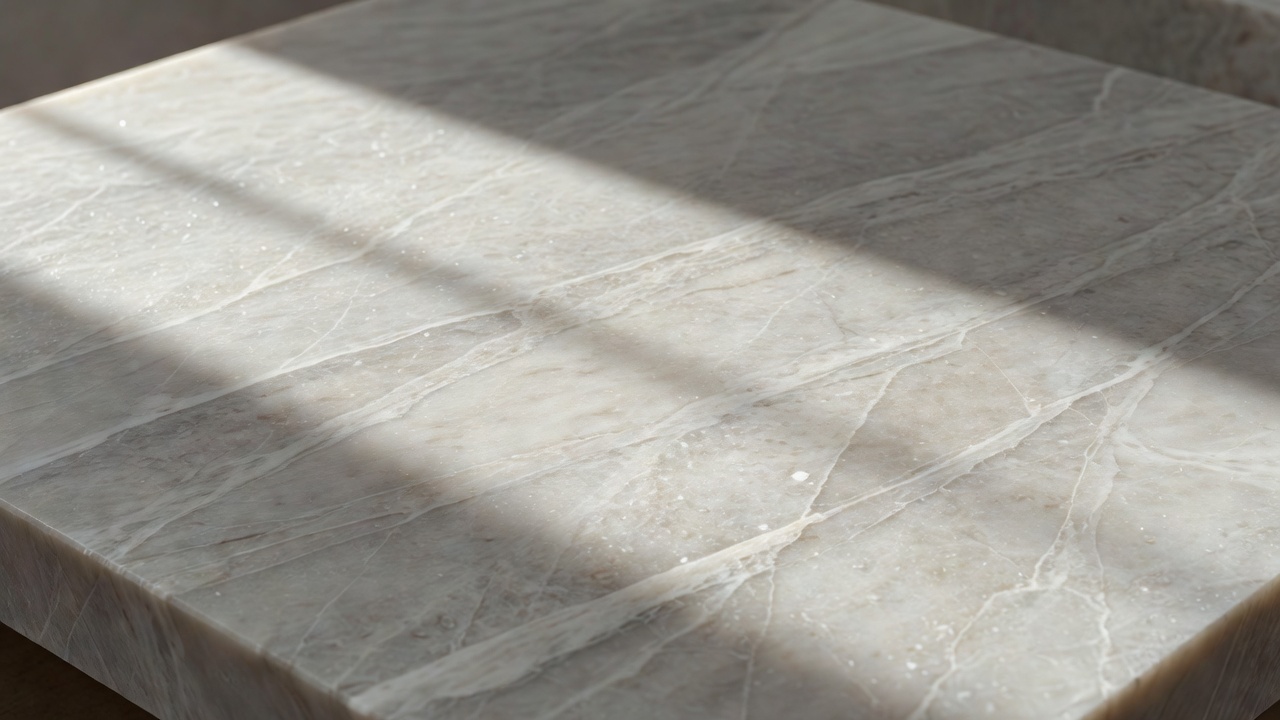
Touch a polished stone and then a honed sample of the same material. Their temperature may be similar, yet the visual impression can be entirely different. A crisp highlight makes one feel formal and sharply defined. A diffuse reflection makes the other feel quieter. Those impressions matter, but they should be evaluated alongside cleaning, traction and the way marks will become visible.
Separate sheen from texture
Polishing progressively refines a surface until it returns a more coherent reflection. Honing usually stops at a lower level of refinement, leaving a matt or satin appearance. Neither word describes one fixed numerical result across the industry. One fabricator’s honed sample may have noticeably more sheen than another’s. Always approve the actual proposed finish rather than relying on its name.
Texture is a related but different quality. A brushed surface may have subtle relief around mineral grains. Bush-hammering creates a more pronounced mechanical texture. Flaming uses heat and is appropriate only for suitable stones and circumstances. Some treatments can affect thickness, colour, strength at the surface or the visibility of repairs. The processing method should be compatible with the specific stone.
Compare the trade-offs, not a hierarchy
| Finish | Light and touch | Questions for daily use |
|---|---|---|
| Polished | Clearer reflections; colour can appear deeper | How visible are etching, fingerprints and fine scratches? |
| Honed | Diffuse reflection; smooth feel | Will oil, moisture or local burnishing create contrast? |
| Brushed | Variable relief and softened highlights | Can the cleaning method reach the low points? |
| Pronounced texture | Strong shadows and more tactile variation | Is it comfortable, cleanable and tested for the intended use? |
A honed limestone can look calm under broad daylight while showing dark hand marks under a nearby pendant. A polished marble may hide some darker moisture traces yet make an acid etch conspicuous because the damaged patch interrupts its reflection. These are possible behaviours, not guarantees. The exact stone, surface treatment, light direction and observer position all influence what is seen.
Bring the room to the sample
Place finish samples horizontally if they will become a worktop and vertically if they will become a wall. Look from standing and seated positions. Test them beside the actual cabinet colour, metal finish and flooring. A small piece viewed upright in a showroom can look surprisingly different when it lies beneath a window at home.
Include the proposed lighting in the review. A narrow beam grazing a wall can reveal tool marks, slight lippage and local changes in sheen that a broad ceiling light barely shows. The aim is not to expose every microscopic variation as a defect. It is to agree on a realistic visual standard before full production. Lighting and surface workmanship should be reviewed together.
For floors, never infer slip resistance from appearance or the feel of a dry hand. Surface texture, footwear, contaminants, water and cleaning residues interact. Ask for appropriate test evidence, such as assessment using relevant methods in EN 16165, interpreted for the intended setting. A polished wall sample tells you very little about the suitability of that stone as a shower floor.
Specify what can be repeated
Retain a signed control sample with the finish, supplier and stone identification recorded. Where a project uses both factory-finished slabs and site-finished edges, check that their sheen can be matched acceptably. An edge polished by hand may not return light in exactly the same way as a broad machine-finished face. Discuss that distinction at the mock-up stage.
Ask whether fillers, resins, waxes, colour enhancers or impregnating treatments are present. These can affect appearance and future maintenance, and they may behave differently on exposed edges. “Natural stone” does not mean an untreated surface. The treatment record should accompany the care instructions so that a later cleaner or restorer knows what is already there.
Finally, consider repair. Local refinishing can leave a visible halo if its sheen does not match the surrounding area. Sometimes a larger section must be refinished for a consistent result. Choose a finish you like now, but also ask how it can be maintained when the room is occupied. The most useful finish is not necessarily the least reflective one; it is the one whose appearance and upkeep fit your expectations.